Medically Reviewed by:
Why Is a Dilated Eye Exam Important?


March is National Save Your Vision Month and while you may think that having good vision means that your eyes are healthy, that may not always be the case. A comprehensive eye exam that include dilation is important to help your doctor see the early symptoms of both vision-related and overall health problems.
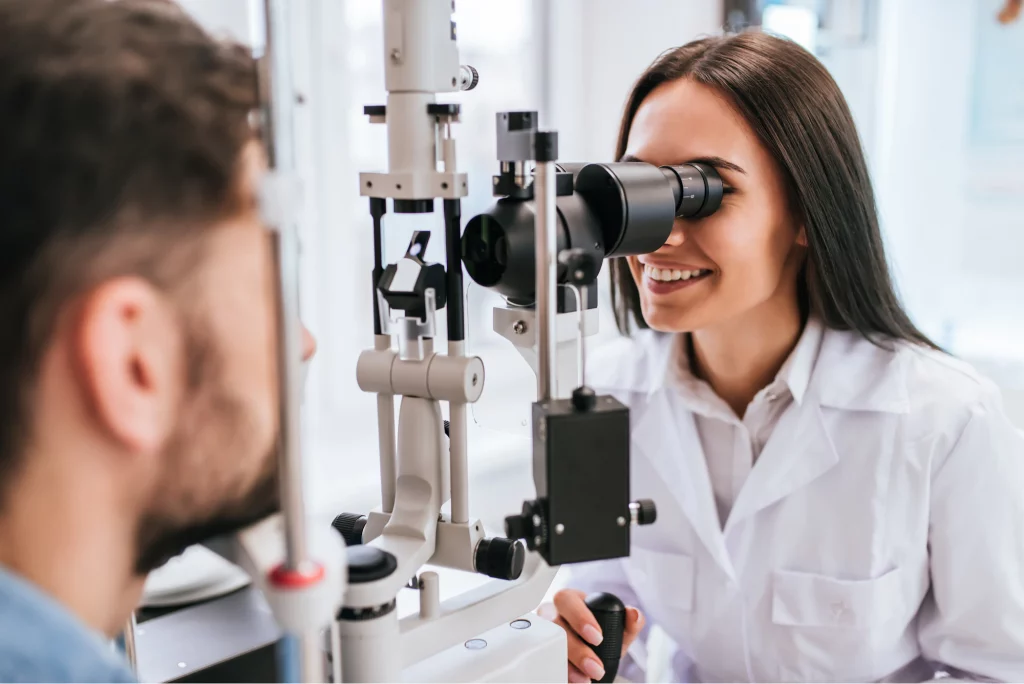
When your eyes are dilated, your eye doctor can view the entire retina, including the blood vessels and optic nerve. This allows your doctor to see early signs of damage that could be indicators of serious conditions such as diabetes, tumors, high blood pressure, infectious diseases, macular degeneration and retinal detachment as well as other conditions.
If your doctor recommends dilation, he or she will put special drops in each eye to widen the pupil, which is the opening in the center of the iris (the colored part of the eye). Dilating the pupil allows more light to enter the eye the same way opening a door allows light into a dark room. Once dilated, each eye is examined using a special magnifying lens that provides a clear view of important tissues at the back of the eye, including the retina, the macula, and the optic nerve.
In a person with diabetic retinopathy (the most common diabetic eye disease and a leading cause of blindness in the United States), the exam may show swelling or leaking of blood vessels in the retina, the light-sensitive layers of tissue at the back of the eye. Your doctor may also see abnormal growth of blood vessels in the retina associated with diabetic retinopathy.
In age-related macular degeneration (AMD), a common cause of vision loss and blindness in people over the age of 50, the exam may show yellow deposits called drusen or clumps of pigment beneath the retina. In some cases, the exam may also show abnormal growth of blood vessels beneath the retina. These AMD-related changes tend to cause deterioration of a small area of the retina called the macula, which is needed for sharp, central vision.
A comprehensive dilated eye exam is also critical for detecting glaucoma, a disease that damages the optic nerve, which carries information from the eyes to the brain. In a person with glaucoma, the dilated exam may show changes in the shape and color of the optic nerve fibers. The exam may also show excessive cupping of the optic disc, the place where the optic nerve fibers exit the eye and enter the brain.
While your eyes are dilated, they will be more sensitive to light. If you do not have sunglasses with you, the doctor’s office will have disposable shades for you to use as you leave. You may also experience difficulty with close-up vision until the drops wear off, usually within a few hours.
Please remember, getting a delated eye exam can save your vision.
Related Articles



Medically Reviewed by:
Do You Know How to Identify Eye Health Risks?
You can do many things to keep them healthy and make sure you’re seeing your best. Follow these simple guidelines for maintaining healthy eyes.
Diabetes – High blood sugar may cause the lens to swell, leading to distorted vision and can lead to diabetic retinopathy, a leading cause of blindness.
Obesity and High Blood Pressure – Being overweight or obese increases your risk of developing diabetes and other systemic conditions, which can lead to vision loss, such as diabetic eye disease or glaucoma.
Smoking – The risk of cataracts more than doubles for people who smoke and the risk of developing age-related macular degeneration (AMD) is three times higher.
Know your Family’s Eye Health History – Talk to your family members about their eye health history. It’s important to know if anyone has been diagnosed with an eye disease or condition since many are hereditary. FYI…a very strong genetic correlation exists with glaucoma.
Eat right to protect your sight – Eating a diet rich in fruits and vegetables—particularly dark leafy greens, such as spinach, kale, or collard greens—is important for keeping your eyes healthy. Research has also shown there are eye health benefits from eating fish high in omega-3 fatty acids, such as salmon, tuna, and halibut.
Prolonged Use of Corticosteroid Medications – the use of inhaled and oral steroids as well as eye drops containing steroids can accelerate the development of cataracts and contribute to glaucoma.
Drinking Excessive Amounts of Alcohol – chronic drinkers are at a higher risk for eye disorders.
Previous Eye Injury or Eye Surgery – this is the leading cause of cataracts in people under 40.
Wear Your Shades – When purchasing sunglasses, look for ones that block out 99 to 100 percent of both UV-A and UV-B radiation.
Give your eyes a rest. If you spend a lot of time at the computer or focusing on any one thing, you sometimes forget to blink and your eyes can get fatigued. Try the 20-20-20 rule: Every 20 minutes, look away about 20 feet in front of you for 20 seconds.
Our doctors, Dr. Mark L. Mayo, Dr. Edward Wade, Dr. Ting-Fang Suarez, and Dr. Paul Stewart recommend if any of these factors are creating vision problems, schedule a comprehensive dilated eye exam with your eye doctor.
Related Articles
Medically Reviewed by:
Eat Right For Your SIGHT!
Proper nutrition is critical to good eye health.
- Eat Lots of Vegetables and Fruits – Antioxidants protect against oxidation, which is a part of the process of macular degeneration (AMD). Dark green leafy vegetables like spinach, kale, mustard greens, and collard greens contain high levels of lutein, a critical antioxidant. Antioxidants are also present in fruits and vegetables with bright color, including red grapes, peppers, corn, oranges, cantaloupe, and mango. Look for fresh produce in a variety of colors to get a wide range of vitamins in your diet.
- Eat Fish – People who eat fish 2-3 times a week have a lower risk for AMD. Fish contain omega-3 which seems to be a critical nutrient for the heart and eyes. The best fish are either wild salmon or small fish like sardines. If you cannot tolerate fish or obtain it easily, an omega-3 supplement is another option.
- Limit Your Fat Intake – In reviewing studies on fat, researchers found that while the amount of fat consumed makes a difference, the real issue for AMD is the number of saturated fats a patient consumes. The biggest source of saturated fat is animal products – beef, lamb, pork, lard, butter, cream, whole milk, and high-fat cheese. Plant oils also have saturated fat, including coconut oil, cocoa butter, palm oil, and palm kernel oil. Read the labels on processed foods and baked goods, as they often have high amounts of saturated fats. Instead, consume healthy fats like olive oil or avocado.
In addition to eating right Dr. Mark Mayo, Dr. Edward Wade, Dr. Ting-Fang Suarez, and Dr. Paul Stewart suggest you follow the below to help prevent AMD:
- Don’t Smoke
- Exercise regularly, and maintain a healthy weight
- Keep your blood pressure and cholesterol under control
- Wear sunglasses outdoors to block UV that may cause eye damage
- Have regular eye exams.
Related Articles
Medically Reviewed by:
Living with AMD
While there is no cure for Age-related Macular Degeneration (AMD), there are steps you can take to help reduce your risk of progression.
Monitor your vision weekly.
Use an Amsler grid, a tool that helps you monitor subtle changes in your central vision. Some forms of AMD can progress very quickly. Monitoring your vision weekly can help you notice any changes. If you do notice changes, talk to your eye doctor immediately.
Keep your eye doctor appointments.
Experts recommend a comprehensive eye exam at least once a year for everyone. Some changes in vision may be best detected by an eye care professional, so it’s important to keep your eye appointments, as directed.
If you smoke, quit.
We know it’s not easy. But stopping smoking may be the most important thing you can do to help reduce your risk of AMD progression. Consider creating a plan to stop smoking that is tailored specifically to your needs and habit.
Maintain your overall health. High cholesterol and blood pressure can increase your risk of AMD. Try to exercise for 30 minutes a few times a week. Consult your doctor before starting any exercise routine. Strive for a balanced diet rich in fruits and vegetables, particularly dark, leafy greens. Get your blood pressure and cholesterol levels checked.
Consider low-vision aids.
Many people with AMD may also benefit from the help of low-vision aids, devices designed to help people with low vision function better, such as handheld magnifiers.
Related Articles
Medically Reviewed by:
Be My LASIK Valentine
Valentine’s Day 2016 is this Sunday…and if your sweetheart wears glasses and/or contacts, how about giving the gift of better sight? LASIK may not be the most romantic gift, but unlike chocolate or flowers the gift of sight will last a lifetime! Think about it, you could look into your sweetheart’s eyes – without looking through glasses!
All-Laser LASIK at Eye Center of Texas is a state-of-the-art method of laser vision correction that leaves the vast majority seeing 20/20 or better. LASIK is quick, simple and relatively painless solution to correct refractive errors such as nearsightedness or farsightedness, with or without astigmatism.
LASIK Gift Certificates are available by calling 713-395-1515 (ask for Steve or Kathy).
They will be happy to help create the perfect Valentine’s Day LASIK Certificate!
Related Articles
Medically Reviewed by:
National AMD and Low Vision Awareness Month
February is National Age-related macular degeneration (AMD) /Low Vision Awareness Month. Age-related macular degeneration is the leading cause of vision loss for individuals age 50 and older. Macular degeneration is a progressive, usually painless disease that affects the macula, the spot on the retina at the back of the eye responsible for central vision, causing central vision to blur, but leaving peripheral vision intact. In its earliest stages, AMD can be difficult to diagnose. In some cases, AMD progresses so slowly that many do not notice a change in their vision. In other cases, the deterioration is very rapid and can appear to happen overnight.
There are two major types of AMD, a “dry” and a “wet” form. The dry form is the early stage and is the most common form of AMD. There is usually little or no vision loss during this stage although there are exceptions with some people having significant vision loss from more advanced “dry” degeneration. The wet form is a late stage of the condition and affects about 10 percent of all people with the condition. Wet AMD accounts for the majority of central vision loss due to AMD.
The wet stage is when abnormal blood vessels start to grow beneath the center of the macula and, as they grow, they leak fluid or blood and cause central vision loss with blurring and distortion of vision. Untreated, these abnormal blood vessels typically will grow relatively large and eventually cause scarring with permanent and often severe central vision loss.
Signs & Symptoms of AMD (If you notice changes to your vision in the following areas you should speak with your doctor particularly if you are older than 50):
- You notice a blurred / blind spot in the center of your field of vision
- You require more light when reading
- You find it difficult to adapt to low lit areas
- Printed words become slightly blurry
- Colors do not seem as bright
- Sometimes you have difficulty recognizing faces
- Your overall vision is becoming hazy
Causes of Macular Degeneration
Even though there is no known exact cause for Macular Degeneration, its origins are considered multi-factorial and the following factors may place you at a higher risk:
- Family history of Macular Degeneration
- Low macular pigment density
- Smoking
- High cholesterol
- Farsightedness
- Poor Diet / Obesity
- Sun exposure
What is Low Vision?
People with low vision find everyday tasks difficult to do – even with the aid of regular glasses, contact lenses, medicine or surgery. Reading the mail, shopping, cooking, seeing the TV and writing can seem challenging.
Just one more reason to see your eye doctor regularly for early detection of AMD. To schedule an appointment, call our office at 713-797-1010 or schedule an appointment using our convenient online form
Related Articles
Medically Reviewed by:
Learn About Glaucoma from Bono
For two decades Bono’s insistence on wearing sunglasses, even when indoors, has been seen simply as part of his rockstar image. But did you know that his trademark shades are instead there to alleviate difficulties caused by glaucoma? For the past 20 years he has had glaucoma, a condition that can make eyes more sensitive to light. Click on the link below: “4 Things You Can Learn About Glaucoma From Bono”:
http://www.aao.org/eye-health/tips-prevention/glaucoma-bono-u2
Related Articles
Medically Reviewed by:
Glaucoma Awareness Information
According to the National Eye Institute(NEI), of the 2.7 million Americans who have glaucoma, 50 percent don’t know it. Glaucoma is a condition in which pressure in the eye damages the optic nerve and most patients have no symptoms at all in its early stages. If left untreated, it can lead to vision loss and blindness.
To see how glaucoma affects your vision? Check out this glaucoma vision simulator:
http://www.aao.org/eye-health/diseases/glaucoma-vision-simulator
Everyone is at risk for glaucoma, from babies to senior citizens, according to the Glaucoma Research Foundation. In the U.S., more than 120,000 people are blind from glaucoma, and glaucoma is the second leading cause of blindness in the world. Blindness from glaucoma is six to eight times more common in African-Americans than Caucasians.
The good news is…glaucoma can be detected in its early stages through a comprehensive dilated eye exam.
Related Articles
Medically Reviewed by:
Have Glaucoma & Cataracts?
Today there is good news for patients considering cataract surgery and who have glaucoma. The FDA-approved iStent is great news for people who have both a cataract and glaucoma,” says Dr. Mark Mayo. The eye drops used to treat glaucoma can be difficult to administer and expensive. With iStent, many patients will need less medicine to control their eye pressure and some may not need prescription eye drops at all.” Studies have shown that more than 90% of patients do not comply with their ocular medication dosing regimens and nearly 50% discontinue taking their medications before 6 months. Dr. Mayo cautions that, “This can be a serious problem. When pressure in the eye is out of control, it can increase the risk for permanent vision loss. I consider iStent an important advancement in protecting against vision loss for my glaucoma patients.”
How Does iStent Work?
iStent works like the stents used to prevent heart attacks and strokes. When blood vessels get clogged, a stent creates access to the vessel flow. While a highly innovative technology, how iStent works is elegantly simple:
- If you have glaucoma, over time the eye’s natural drainage system becomes clogged
- iStent creates a permanent opening through the blockage to improve the eye’s natural outflow & spares the eye tissue often damaged in traditional surgeries
- Restoring this mechanism lowers and controls pressure within the eye
iStent is the smallest medical device ever approved by the FDA. It is placed in your eye during cataract surgery and is so small that you won’t be able to see or feel it after the procedure is over. It is 20,000 times smaller than the lens implanted during cataract surgery. iStent is designed to create a permanent opening in your trabecular meshwork, and works continuously to improve the outflow of fluid from your eyes to help control eye pressure.
iStent Q & A:
- What causes high eye or intraocular pressure?
Your eye uses an intricate fluid outflow system to keep it balanced and healthy. At the center of this system is the trabecular meshwork. In patients with open-angle glaucoma, a blockage in the trabecular meshwork keeps the fluid in your eye from draining properly. When this happens, fluid backs up and eye pressure rises. - How does iStent lower eye pressure?
iStent is designed to create a permanent opening in your eye’s drainage system to improve the outflow of fluid from your eyes. By increasing fluid outflow, iStent lowers pressure within the eye. - How big is the stent?
It is about the size of the letter c in the word cent on a penny. In fact, it is the smallest medical device ever approved by the FDA. - Is iStent safe?
Yes. iStent is a safe glaucoma treatment and has been approved by the FDA for mild to moderate open-angle glaucoma. - Will I be able to feel or see the iStent in my eye?
No. iStent is so small you won’t be able to see or feel it after the procedure. - Does iStent hurt?
No. iStent does not hurt. You will not even know it is there. - Will I be able to stop taking my glaucoma eye drops?
In a U.S. clinical trial, iStent patients who achieved a target pressure of <21, were more likely not to need their medications than patients with cataract only surgery. It helps decrease the likelihood that a second glaucoma medication would need to be added in the future. - How much does iStent cost?
iStent is covered by Medicare and many private insurance plans.
Related Articles
Medically Reviewed by:
January Is Glaucoma Awareness Month
January is National Glaucoma Awareness Month and the Eye Center of Texas wants to help raise awareness of the disease by reminding mid-life and older Houstonians to get regular eye examinations.
Glaucoma is a disease that gradually takes an individual’s sight without warning. Although the most common forms of the disease primarily affect middle-aged adults and the elderly, glaucoma has no age boundaries. Glaucoma is the leading cause of preventable blindness and can affect people of all age groups, including infants and children. Those at high risk of getting the disease are African-Americans, individuals of Latino ancestry, persons over age 60, and immediate family members of those who have been diagnosed with glaucoma. More than 3 million Americans and about 70 million people worldwide have the disease, with most being unaware that they have it. Because peripheral or side vision loss begins first, a person may not be aware he has the disease until he has lost a large amount of his sight.
The two most common types of the disease are primary open angle glaucoma – which is hereditary, and angle closure glaucoma. If an individual has been diagnosed with glaucoma, he should let his family know that they are at an increased risk of getting the disease. To prevent glaucoma, at risk individuals and persons over age 40 should have regular eye exams that include measurement of eye pressure, and a careful evaluation of the optic nerve, which is the part of the eye that sends images of what a person sees to the brain.
Eye Center of Texas urges you to get an dilated eye exam from your eye doctor. And while ECT doesn’t do regular eye exams, we co-manage with 275+ Houston area Optometrist. If you don’t have an Optometrist, call us or click on the below link and find optometrist in your desired zip code.
Find an optometrist for your routine eye exam
Related Articles
Financing Options Available
Apply today to find a financing option that meets your needs.
Our Locations
Houston/Bellaire
6565 W. Loop S., Suite 650Bellaire, TX 77401
Medical Office:
713-797-1010
Medical Fax:
713-357-7276
LASIK/Near Vision:
Office: 713-395-1515
Fax: 713-357-7278
Pasadena
4415 Crenshaw RoadPasadena, TX 77504
Medical Office:
281-977-8800
Medical Fax:
281-977-8877
Sugar Land
15200 S.W. Freeway, Suite 130Sugar Land, TX 77478
Medical Office:
281-277-1010
Medical Fax:
281-277-4504
Clear Lake
455 E. Medical Center Blvd., Suite 110Webster, TX 77598
Medical Office:
281-332-1397
Medical Fax:
281-282-9152
Katy
Greenhouse Medical Plaza2051 Greenhouse Road, Suite 110
Houston, TX 77084
Medical Office:
346-547-7070
Medical Fax:
281-214-2971
The Woodlands/Conroe
100 Medical Center Blvd., Suite 118Conroe, TX 77304
Medical Office:
936-647-1610
Medical Fax:
936-647-1620