Medically Reviewed by:
The Heart Truth


February is National Heart Disease Awareness Month and National AMD (Age-Related Macular Degeneration) and Low Vision Awareness Month
Some of the same things that put you at risk for heart disease and stroke also put you at risk for AMD. These include:
- High blood pressure
- High cholesterol
- Obesity
- Smoking
You can tackle several risk factors at once by doing these 4 things: eat healthier foods, exercise, stop smoking and take your medications as instructed.
Related Articles



Medically Reviewed by:
Macular Degeneration and the Amsler Grid
Macular degeneration (AMD) is a chronic eye disease associated with aging that gradually destroys central vision. It is one of the leading causes of legal blindness and vision impairment in older Americans. AMD affects central vision, but not peripheral vision – therefore, it doesn’t cause total blindness. The progression of AMD can be slow or rapid, but the deterioration of central vision generally occurs over a period of a few years.
There are two types of AMD, dry and wet. The dry form occurs in approximately 90 percent of those with AMD. The wet form only occurs in 10 percent of those with AMD, but it accounts for 90 percent of all severe vision loss from the disease. “Wet” is a chronic condition with no cure, but it can be treated with photodynamic therapy (PDT), conventional laser, and anti – VEGF medication treatments, or combination therapies.
Like other chronic diseases, wet AMD requires that people with the condition take an active role in monitoring their symptoms. The Amsler grid is a safe and simple, self-administered screening test used to evaluate possible problem areas in the macular.
Test each eye separately. Cover the eye that you are not using · Keep the grid about 14 inches away · Look directly at the dot in the center of the grid · If you normally wear glasses, do so while looking at the grid
Repeat this test on your other eye. If you notice blurry or wavy lines, and dark or blank spots you may have a vision problem in the eye and you should call your eye doctor.
Early detection and treatment are the best defense of losing your vision.
Related Articles
Medically Reviewed by:
January is Glaucoma Awareness Month
What is Glaucoma?
Glaucoma is a serious condition that involves an elevation in pressure inside the eye caused by a build-up of excess fluid. Left untreated, it can destroy the optic nerve, which is the main nerve of the eye. Glaucoma is one of the leading causes of blindness in the world today…but it doesn’t have to be.
In most cases, it is a painless disease…and there are no symptoms other than loss of vision, which can occur so gradually that many people do not realize it is happening. The first vision loss is usually peripheral vision (what you see off to the sides when you are looking straight ahead).
Glaucoma cannot be cured, but it can be treated. If it’s diagnosed
in its early stages, blindness can almost always be prevented. Because it is painless, it is very important that patients have regular eye exams. This is especially true for people who:
- Have a family history of the disease
- Are of African-American descent
- Over the age of 40
Possible Signs of Glaucoma:
If you are suddenly experiencing the following symptoms, you may have glaucoma and should seek immediate treatment:
- Blurred vision
- Nausea
- Headaches
- Halos around bright light
The Eye Center of Texas treats all types of glaucoma. The most common is called ‘open-angle’ glaucoma. It occurs in 80% of all people with glaucoma and most ‘open-angle’ cases are treated with eye drops that we prescribe in the office. We also offer laser trabeculoplasty or SLT. The SLT (which is covered by most insurance plans) treats intraocular pressure by gently opening up the drainage canal of the eye with multiple laser spots.
To schedule your glaucoma evaluation, call the Eye Center of Texas at 713-797-1010
Related Articles
Medically Reviewed by:
Macular Degeneration (AMD)
Macular Degeneration (AMD) is a chronic eye disease associated with aging that gradually destroys central vision. Itʼs one of the leading causes of legal blindness and vision impairment in older Americans. AMD affects central vision, but not peripheral vision – therefore, it doesn’t cause total blindness. The progression of AMD can be slow or rapid, but the deterioration of central vision generally occurs over a period of a few years. Pain is not associated with AMD, but if you experience any of the following conditions make an eye appointment right away:
- Straight lines appear wavy
- Difficulty seeing at a distance
- Decreased ability to distinguish colors
- Inability to see details, such as faces or words in a book
- Dark or empty spots block the center of your vision
Although the exact cause of Macular Degeneration is unknown, several studies have shown the following are more at risk:
- People age 50 and older
- People with hypertension
- People who smoke
- People with a family history of AMD
There are two types of AMD: “dry” and “wet”: The “dry” form of Macular Degeneration occurs in approximately 90 percent of those with AMD. Studies have found that high levels of zinc and antioxidants play a key role in slowing the few specific forms of “wet” macular degeneration.
Early detection and treatment are the best defense against losing your vision.
Related Articles
Medically Reviewed by:
Are Eye Exams Really Important?
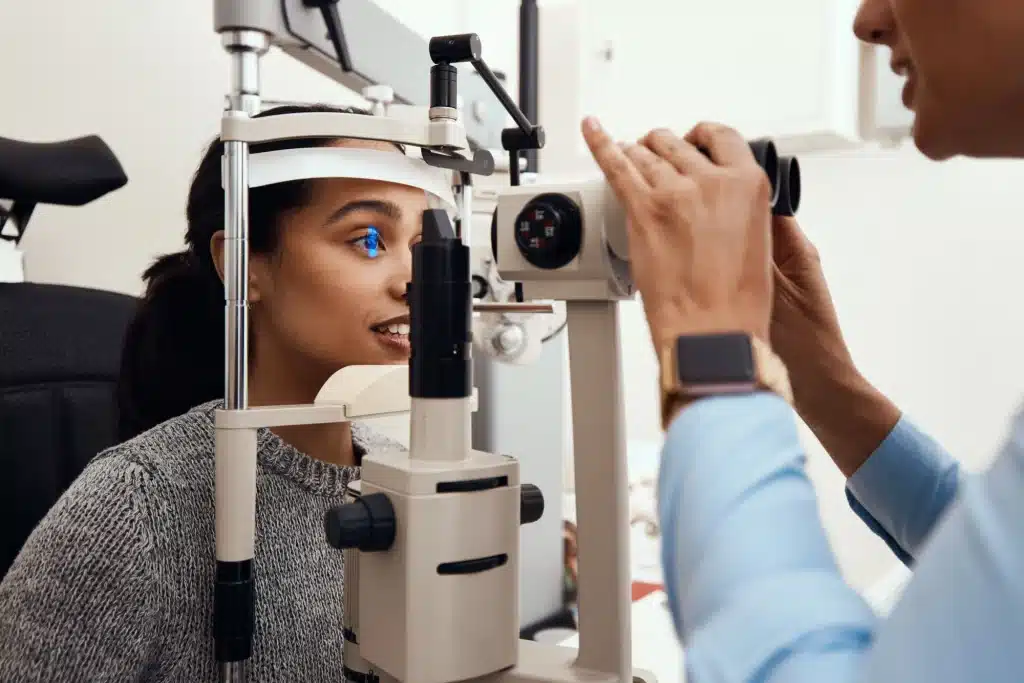
Yes, it is important to have a comprehensive eye exam at least once a year. A comprehensive eye exam includes dilation – which allows for the evaluation of diseases such as hypertension, diabetes, and glaucoma and even life-threatening conditions like a brain tumor.
In 2013 Dr. Wade saw a patient…who had been seeing another ophthalmologist since 2009. Dr. Wade ordered additional tests – which determined the patient had a tumor on his pituitary gland that was pressing on his optic nerve, which was causing loss of vision. Dr. Wade immediately scheduled an MRI and referred him to a neurosurgeon at Methodist Hospital. Following the removal of the macro adenoma tumor, his vision has been totally restored.
Dr. Autry saw a child who was complaining of headaches (his vision blurry in one eye) and after she dilated and looked behind his eyes she discovered a tumor. She immediately called Texas Children’s Hospital where his tumor was removed.
While these are extreme cases, there are eye diseases like glaucoma that can steal sight without any pain, symptoms or signs…and if not treated can cause permanent loss of vision. Other diseases can also be detected by looking at your blood vessels, and retina. They may be able to tell you if you are developing high blood pressure, high cholesterol or other problems. And if you have diabetes, an annual eye exam is the most important thing you can do for your eyes. (Further reading: diabetic retinopathy surgery)
Eye Center of Texas is preferred by hundreds of eye doctors for Houston LASIK, cataracts, and other advanced treatments. Request an appointment today.
Related Articles
Medically Reviewed by:
Over 40, Presbyopia & LASIK?
Presbyopia is a condition in which the lens of the eye loses its ability to focus, making it difficult to see objects up close. Pretty much everyday we get this question: Since I’m over the age of 40, will I will be able to see both at distance and near without glasses after LASIK eye surgery?
Unfortunately the answer is no. However, there are some great options for patients over the age of 40:
- LASIK with Monovision: this involves correcting the dominant eye for distance vision, and correcting the other eye for near vision. Monovision does involve some degree of compromise and not everyone likes it therefore our doctors highly recommend patients considering monovision first try monovision with contact lenses.
- Refractive Lens Exchange surgery replaces the eye’s natural lens with an artificial lens to reduce the overall prescription and improve the range and focus of vision. It is basically cataract surgery done for the purpose of correcting vision even when no cataract is present. We offer premium intraocular lenses including the FDA approved ReSTOR and nanoFLEX that can reduce or eliminate your dependency on glasses or contacts. The ReSTOR multifocal lens corrects vision at all ranges (near, intermediate and distance). The nanoFLEX is blended vision and takes monovision correction to a whole new level. Once you have this surgery, you will never have a cataract.
Our doctors and counselors will help guide you to the options that work best to suit your lifestyle. Eye Center of Texas is a leading Houston LASIK provider, the choice of hundreds of Houston eye doctors. Eye patients may find a number of useful resources on the Eye Center of Texas blog, including content about: “I have a bump on my eyelid“, “Pain in my eye socket“, “My eyes are red all the time“, and “How to tell if your eyesight is getting worse“.
Related Articles
Financing Options Available
Apply today to find a financing option that meets your needs.
Our Locations
-
455 E. Medical Center Blvd., Suite 110, Webster, TX 77598- Medical Office:
- 281-332-1397
-
22215 Cypresswood Dr., Suite 116
Cypress, TX 77433- Medical Office:
- 346-537-0088
- Medical Fax:
- 346-537-0187
-
6565 W. Loop S., Suite 650, Bellaire, TX 77401- Medical Office:
- 713-797-1010
-
Greenhouse Medical Plaza
2051 Greenhouse Road, Suite 110
Houston, TX 77084- Medical Office:
- 346-547-7070
- Medical Fax:
- 281-214-2971
-
4415 Crenshaw Road, Pasadena, TX 77504- Medical Office:
- 281-977-8800
-
15200 S.W. Freeway, Suite 130, Sugar Land, TX 77478- Medical Office:
- 281-277-1010
-
100 Medical Center Blvd., Suite 118
Conroe, TX 77304- Medical Office:
- 936-647-1610
- Medical Fax:
- 936-647-1620
No locations match that search.