Medically Reviewed by:
Eyelid Surgery


Eyelid Surgery Overview
Houston Eyelid Surgery
Upper Blepharoplasty (Upper Eyelid Enhancement)
The eyes are the primary facial feature that communicates tiredness or exhaustion (and, likewise, energy and vitality). Your cheeks and your neck don’t really reflect whether or not you’ve had a good night’s rest. But miss a night of sleep and your eyes will make it obvious to everyone. Dr. Mark Mayo can help you combat the signs of aging around the eyes with upper eyelid surgery. Eyelid surgery (technically called “blepharoplasty”) is a procedure to remove fat – usually along with excess skin and muscle – from the upper eyelids. Eyelid surgery can correct excess, hanging skin covering the natural fold of the upper eyelids – features that make you look older and more tired than you feel, and may even interfere with your vision.
Aesthetic plastic surgery of the eyelids can produce a dramatic rejuvenating effect, literally taking years off of a person’s appearance and is a popular procedure for men as well as women. Many patients find that following eyelid surgery friends will say ‘You look great!’, but they usually cannot pinpoint exactly why.
Excessive or ‘redundant’ upper eyelid skin is a very typical aging change that leads people to seek eyelid surgery. In many patients, this surgery can be performed under light sedation with local anesthesia as an outpatient office procedure. In some cases, protruding fat behind the eyelids is also removed. As with most facial aging changes, no two people present with exactly the same eyelid concerns. Surgical treatment is therefore individualized to the needs of each individual patient.
The entire procedure typically takes 45 minutes to one hour. After the procedure, one may experience some bruising and mild swelling for one to two weeks. Cold compresses the first day and head elevation will reduce these effects. An eyelid ointment is used postoperatively for one to two weeks. Post-op discomfort is usually mild. The sutures we use are absorbed and don’t need to be removed, most patients can resume most normal activities within a few days.
Blepharoplasty is often considered a cosmetic surgery. However, if your eyelids are encroaching on your field of vision or causing chronic irritation, the procedure may be covered as medically necessary. We are happy to contact your insurance to determine if they cover the procedure.
Related Articles
Medically Reviewed by:
Eye Diseases
Corneal eye diseases, conditions, & treatments
Your cornea is the dome-shaped, transparent outer lens of the eye. It protects the iris, anterior chamber, and pupil from debris and germs. It also is the primary focuser of light entering the eye; the cornea bends (refracts) light onto the lens. The cornea can lose its shape, grow cloudy, and suffer from infections. The following are common corneal eye diseases and corneal surgeries treated at the Eye Center of Texas.
- Astigmatism: a condition in which an unevenly rounded cornea creates refractive errors, resulting in vision problems.
- Treatment: LASIK eye surgery.
- Treatment: LASIK eye surgery.
- Corneal abrasion: a frequently occurring condition in which the cornea has been scratched.
- Treatment: either prescription eye drops, lubricating drops, antibiotic drops or ointment, or a bandage contact lens, depending on the severity of the abrasion
- Corneal dystrophy: an (often inherited) condition involving the buildup of cloudy substances that cause the cornea to lose clarity.
- Treatment: Keratoplasty (corneal transplantation)
- Treatment: Keratoplasty (corneal transplantation)
- Corneal neovascularization (CNV): a condition caused by lack of oxygen, in which blood vessels grow into the cornea.
- Treatment: antibiotics, corticosteroids, anti-VEGF medication
- Treatment: antibiotics, corticosteroids, anti-VEGF medication
- Fuchs’ corneal dystrophy: a disease in which the endothelial cells at the base of the cornea deteriorate, creating potential corneal swelling.
- Treatment: Keratoplasty (corneal transplantation)
- Treatment: Keratoplasty (corneal transplantation)
- Keratoconus: a progressive eye disease which causes your cornea to thin, then bulge into a cone-like shape.
- Treatment: Corneal cross-linking (CXL)
- Treatment: Corneal cross-linking (CXL)
- Keratitis: an infection often caused by bacteria or a virus that creates corneal inflammation.
- Treatment: antibacterial, antifungal, antiviral, or antibiotic eye drops
Retinal eye diseases, conditions, & treatments
The retina is the thin layer of tissue that lines the inside of the back of the eye. The retina is the part of the eye which takes all the light collected by the lens, organizes it, and translates it into neural signals that it then sends to the brain via the optic nerve. The following are common retinal eye diseases treated at the Eye Center of Texas.
- Diabetic retinopathy: a condition that occurs when high blood sugar damages the capillaries in the retina, causing vision loss and blindness.
- Treatment: better control of blood sugar, anti-VEGF medication, steroids, laser surgery (to shrink blood vessels), vitrectomy.
- Diabetic macular edema (DME): a condition in which the damaged capillaries of diabetic retinopathy are left on treated, causing pressure and leakage.
- Treatment: better control of blood sugar, anti-VEGF medication, steroids, laser surgery, NSAID eye drops.
- Epiretinal membrane (macular pucker): is a condition where scar tissue has formed on the center of the retina (the macula), blurring vision.
- Treatment: vitrectomy or no treatment, depending on the severity
- Flashes and floaters: flashes are caused by vitreous, which pulls on the retina as it shrinks, creating flickers of light. Floaters often follow flashers and are caused by the vitreous coagulating and detaching from the eyewall.
- Treatment: none, unless related to another disease or condition
- Macular degeneration / age-related macular degeneration (AMD): a condition caused by the degeneration of the macula the pigmented area found at the center of the retina. Macular degeneration contributes to loss of central vision.
- Treatment: laser surgery, anti-VEGF medication, glasses, corrective lenses
- Macular hole: a defect found at the center of the retina caused by an injury or tugging of the vitreous (the gel-like substance in your eye).
- Treatment: vitrectomy
- Retinal tears and retinal detachment: a condition that occurs when vitreous shrinks, tugging and tearing the retina. If fluid enters the tear it can cause the retina to detach.
- Treatment: cryotherapy
- Retinal vein occlusion (RVO): a disease in which the blood traveling from your retina to your heart becomes blocked. RVO is sometimes called eye stroke. There are two types: central retinal vein occlusion (CRVO) and branch retinal vein occlusion (BRVO).
- Treatment: laser surgery/therapy, anti-VEGF, corticosteroids
Other eye diseases, conditions, & treatments
- Cataracts: a degenerative eye disease that typically occurs with aging. Cataracts develop on the lens and cause blurred vision.
- Treatment: cataract surgery, laser cataract surgery
- Glaucoma: a condition in which the optic nerve is damaged by increased pressure (ocular hypertension) due to fluid buildup. The onset of glaucoma is slow; many people are unaware that they have glaucoma.
- Treatment: eye drops, laser eye surgery (selective laser trabeculoplasty or endoscopic cyclophotocoagulation), filtration surgery
Our doctors
Dr. Edward Wade and Dr. Mark Mayo are nationally-renowned eye surgeons located right here in the Houston, Texas area. They and their team of doctors operate in five locations throughout Houston and the surrounding areas.
See how our patients describe their time at Eye Center of Texas working with some of the best LASIK surgeons in Houston, Texas.
Treatment at Eye Center of Texas
Eye Center of Texas has helped restore the vision of thousands of Houstonians. Due to our years of experience and our use of only the most advanced eye disease surgical techniques and technology, over 300 Houston-area eye doctors refer their patients to Eye Center of Texas exclusively.
Take that first step towards getting your clear vision back. Contact an Eye Center of Texas facility nearby calling us at 713-797-1010 or requesting an appointment online.
Related Articles
Medically Reviewed by:
Near Vision
Presbyopia: Near Vision Solutions in Houston
Presbyopia is a condition caused by the natural aging of your eyes during which an individual begins to lose ability to focus visually on nearby objects. Also called “near vision,” presbyopia can occur regardless of your vision history and affects all races and genders.
As our population ages, the number of people who struggle with presbyopia is increasing. But there is good news. There are several means of presbyopia prevention, treatment, and surgery through which eye doctors can alleviate presbyopia symptoms.
What is presbyopia of the eye?
When we arrive at age 40, the lenses in our eyes have received enough wear and tear that they begin to lose their flexibility. A lens that has thickened and hardened due to presbyopia and is unable to focus on objects that are nearby.
Note that this thickening is what differentiates presbyopia from myopia (nearsightedness) and hyperopia (farsightedness) which are caused by refractive errors in the lens. (Further reading regarding the difference between nearsighted and farsighted here.)
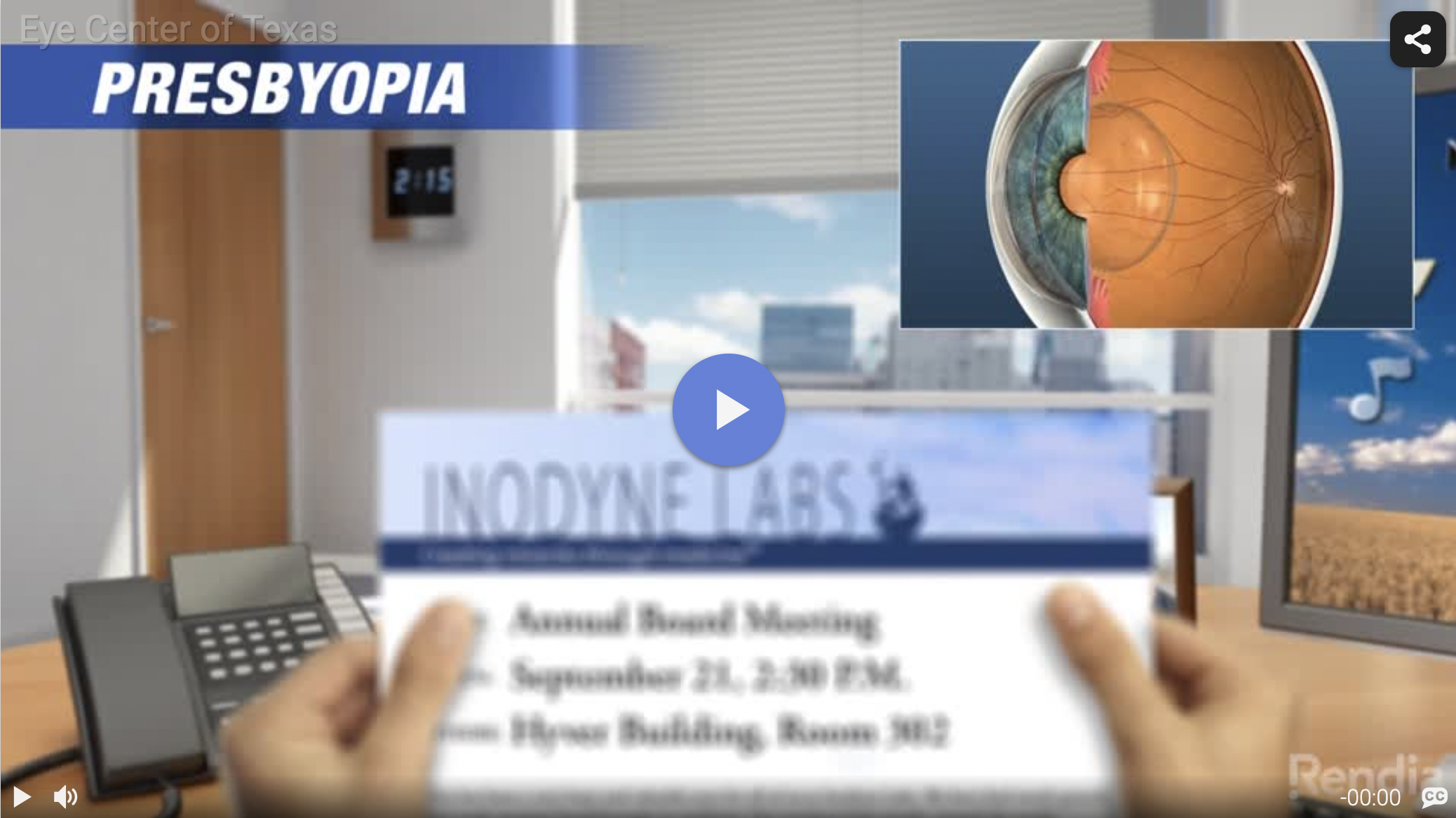
Whereas before the first signs of presbyopia tended to come when individuals had a difficult time reading books or a newspaper, now one of the first symptoms of presbyopia is difficulty reading on our various devices.
If you have ever seen someone hold their phone farther away from their face so that they could read a text message, then chances are you’ve seen presbyopia in action. (Further reading on the question, “Does looking at a screen damage your eyes?” here.)
How is presbyopia diagnosed?
Presbyopia can be diagnosed during a routine eye examination. Even if you have not had eye problems in the past, it is recommended by most eye doctors that all individuals get their eyes tested when they turn 40.
Receiving regular eye checkups after (and, frankly, even before) you turn 40 increase your chances of having healthy eyes for longer, especially as the onset of some eye diseases are not marked by symptoms.
Which lens is used for presbyopia treatment?
We hear this question often at Eye Center of Texas. While there are lenses that do a wonderful job of treating problems with near vision, you may not even need them. If you haven’t had vision problems before, it’s possible that you may be able to get by simply with readers from the drugstore.
That said, patients who already wear prescription lenses to address another vision issue almost always need prescription option to address their near vision. These options include: bifocal glasses or contact lenses, trifocal glasses, monovision contact lenses, and more.
Finally, many patients elect to have eye surgery to treat their presbyopia. The following are popular surgical options for addressing near vision issues.
- Lens replacement for presbyopia, a procedure similar to cataract surgery. In Refractive Lens Exchange, your aged lens will be replaced with an intraocular lens.
- LASIK eye surgery that adjusts your eyes for monovision. (If you know you’re not a good candidate for Houston LASIK, PRK eye surgery is an equally successful alternative.)
Frustrated by near vision problems? Eye Center of Texas is nearby.
Presbyopia can be treated. The staff at Eye Center of Texas has years of experience treating eye diseases and vision issues. Our doctors perform only the safest, most advanced cataract surgical techniques and technology.
Contact us today at 713-395-1515 or schedule an appointment online for more information on presbyopia treatment in Houston.
Related Articles
Medically Reviewed by:
Cataracts
What are cataracts?
To understand cataracts and how to correct them, it helps to understand the eye first. The eye focuses images through a lens inside the eye — like a camera uses a lens to focus.
As we age, the lens becomes cloudy and inflexible, causing our vision to blur and increasing our dependence on corrective lenses to refocus from near to far. A cloudy lens is called a cataract.

Across the globe and in Houston, cataracts cause vision problems, making it progressively more difficult to read, drive, or watch TV. If you are over the age of 50, developing cataracts is a regular part of the aging process. Though very uncommon, some individuals develop cataracts as children or young adults.
How do I know if I have a cataract?
The best and quickest answer to this question is that you need an eye examination in Houston. An eye examination will determine whether or not you have cataracts and. If you do have cataracts, the examination will also help determine whether or not your cataracts are causing significant damage to your vision.
Many patients ask us, “How do you get rid of cataracts naturally?” While there’s not a proven natural way to get rid of Houston cataracts, you may not need surgery. If the cataract is mild, then cataract treatment may not be needed. Quite often, an updated pair of eyeglasses will help to optimize your vision.
However, if your vision remains blurred in spite of correctly prescribed glasses, then the next step may be to consider cataract surgery in Houston. Regardless, it’s best to consult your doctor, so you can avoid asking the question, “What will happen if a cataract is left untreated?”
If your doctor recommends surgery for your Houston cataracts, there are two simple decisions to make: what kind of cataract treatment procedure you’d like, and what kind of lenses you’d like to use.
Cataract surgery options
If you choose to improve your vision through cataract surgery, Eye Center of Texas offers you three types of cataract treatments. Your choice will be determined by how dependent you are on glasses before your surgery and how well you can see without glasses after your surgery.
Here are our three options for cataract surgery:
- Basic cataract surgery with a basic fixed-focus lens implant to see clearly with bifocal glasses.
- Laser cataract surgery with the astigmatism correction package to see far away without glasses
- Laser cataract surgery — lifestyle package with an advanced technology lens designed to see near and far without glasses
Bladeless cataract surgery
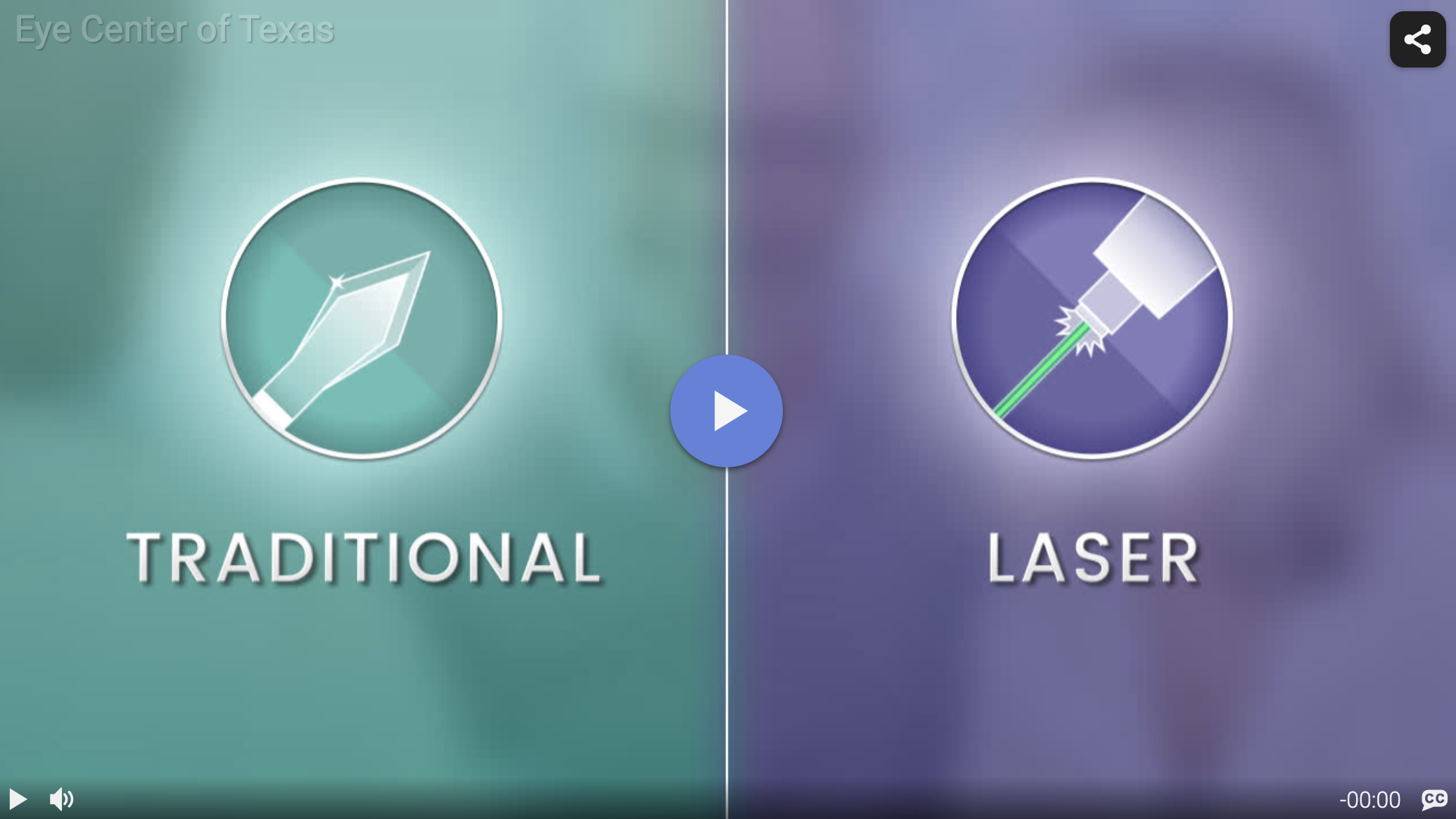
Patients also have the option to choose bladeless cataract surgery. In this procedure, a computer-controlled, bladeless cataract laser performs the most critical steps of the cataract surgery procedure.
Eye Center of Texas was among the first centers to offer this technique. Since then, bladeless cataract surgery in Houston has been one of the most popular choices among our patients.
The LenSx laser is the most technologically advanced option for cataracts patients today. A custom map of your eye is made using the laser which means the cataracts surgery procedure is 100% customized.
Types of lenses
After selecting the operation that is right for you, you’ll have your choice of the kind of lens used to replace your cataract.

Basic Blade Conventional Surgery
- Cataract replaced with implant lens
- See better because cataract has been removed
- Will need glasses and/or contacts for best distance and near vision
Distance Laser – With or Without Toric
- By treating astigmatism, distance vision without glasses is sharper than with conventional implant lens
- Will need to use Computer/Reading glasses
Multifocal Lens Implant
- Trifocal implant
- Also treats astigmatism
- In most cases, there is no need for glasses. Gives distance/computer/reading
- Might have mild halos/glare
Extended Depth of Focus
- Gives Distance/Computer/Dashboard
- Need Readers
- Minimal to no halos
- Also treats astigmatism
Light Adjustable Lens™
- Is the only option that allows fine tuning to your specific prescription, AFTER surgery
- Best option for patients with history of LASIK/PRK/RK
- Best option for previous monovision patients
- Lowest incidence of night glare of all choices
Our surgeons
Our cataract surgeons have years of experience and use the safest, most advanced cataract surgical techniques and technology, all of which allows us to personalize a procedure that will be just right for your eyes.
Knowing how to choose a cataract surgeon is important, and a great way to start is to check their experience and credentials.
Dr. Yasir Ahmed, M.D., is from Baltimore, MD and graduated with a medical degree from Brown University Alpert Medical School and gained additional experience at the esteemed Penn State and Bascom Palmer Eye Institute. Dr. Ahmed completed his medical internship at Harvard’s Mount Auburn Hospital (2012) and his ophthalmology residency at Penn State (2013).
Dr. Nicholas P. Bell, M.D., is a Board Certified ophthalmologist who specializes in glaucoma treatment and performs both traditional and laser cataract surgery. Dr. Bell has been repeatedly named one of Houston’s Top Doctors by both Houstonia and H Texas magazines. Dr. Bell graduated Cum Laude from Duke University with a major in Biology.
Dr. Grant C. Hopping, As a native Houstonian, he served as a High School Biology Teacher in Houston’s Fifth Ward before earning his Doctor of Medicine degree at the McGovern Medical School at UTHealth in Houston. His postgraduate training consisted of an Integrated Internship at Mount Sinai Beth Israel Hospital and an Ophthalmology Residency at the prestigious New York Eye & Ear Infirmary of Mount Sinai in New York City.
Dr. Samuel Long, M.D., Dr. Long earned his medical degree and completed his residency in ophthalmology at the University of Kansas School of Medicine. He pursued a transitional residency internship at Tucson Hospitals Medical Education Program in Arizona.
Dr. Mark Mayo, M.D., is a native Houstonian. He grew up in Spring Branch and is a graduate of Stratford High School. He attended the University of Texas at Austin where he was accepted into the Plan II Interdisciplinary Honors Programs.
Dr. Edward Wade, M.D., F.A.C.S., a native of El Paso, Texas, graduated Summa Cum Laude from the University of Illinois and was awarded the Bronze Tablet Award, a distinction given to only the top 2 percent of the class.
Cataract surgery in Houston: what our patients are saying
A surgeon’s reputation is an important factor when you’re choosing your next cataract surgeon. We encourage you to read through the reviews and testimonials of our satisfied Houston cataract patients.
Having our patients see success is the most rewarding part of our work. For you, clear and vibrant vision could be closer than you think.
Cost of cataract surgery in Houston
For cataract surgery in Houston, cost should never be a barrier to getting rid of cataracts. Many patients find that Medicare and if applicable, private insurance often help with much of the cost.
Here are more details about cataract surgery cost. We encourage you to speak with our doctors and staff to find the best game plan for you.
Experience you can trust
At Eye Center of Texas, we have years of experience and offer the safest, most advanced cataract surgical techniques and technology.
Contact us today at 713-797-1010 or schedule an appointment online for the best cataract surgery Houston has to offer.
Other Popular Treatments at Eye Center of Texas
- Refractive Lens Exchange for Near Vision
- Houston LASIK
- Houston Visian ICL Eye Surgery
- PRK Eye Surgery
- Retina Specialist in Houston
Related Articles
Financing Options Available
Apply today to find a financing option that meets your needs.
Our Locations
Houston/Bellaire
6565 W. Loop S., Suite 650Bellaire, TX 77401
Medical Office:
713-797-1010
Medical Fax:
713-357-7276
LASIK/Near Vision:
Office: 713-395-1515
Fax: 713-357-7278
Pasadena
4415 Crenshaw RoadPasadena, TX 77504
Medical Office:
281-977-8800
Medical Fax:
281-977-8877
Sugar Land
15200 S.W. Freeway, Suite 130Sugar Land, TX 77478
Medical Office:
281-277-1010
Medical Fax:
281-277-4504
Clear Lake
455 E. Medical Center Blvd., Suite 110Webster, TX 77598
Medical Office:
281-332-1397
Medical Fax:
281-282-9152
Katy
Greenhouse Medical Plaza2051 Greenhouse Road, Suite 110
Houston, TX 77084
Medical Office:
346-547-7070
Medical Fax:
281-214-2971
The Woodlands/Conroe
100 Medical Center Blvd., Suite 118Conroe, TX 77304
Medical Office:
936-647-1610
Medical Fax:
936-647-1620
Cypress
22215 Cypresswood Dr., Suite 116Cypress, TX 77433
Main Phone:
(346) 537-0088
Fax Line:
(346) 537-0187